


There are images where you’ll always wonder what’s going on. And really, these are some of the most powerful photographs you can make. In fact, it’s a big part of photojournalism. If you didn’t know about what 9/11 was, for example, you’d find David Handschuh’s award winning image to be rather ambiguous. You’d also then need to acknowledge that there is an entire population of humans who were born after 9/11 who probably would have no idea what the Twin Towers looked like. To them, these photographs would be very ambiguous. To understand this, we have to think about more of the idea of curiosity than ambiguity in photography.
The lead image is one that I shot several years ago. We don’t know what the man is taking a photo of — but we’d be inclined to think that he’s being flashed by the woman. Is that really what happened? Well, we’re not sure because what she’s wearing is ambiguous.


To create ambiguity in your images, you have to shoot something that gets people curious. To that end, you have to look at the world the way a scholar looks at a library. While many photography predecessors will say that they need to attack the streets, we’d instead tell you that you need to want to converse with it.
In his book, How I Make Photographs, Joel Meyerowitz talks about ambiguity. “Ambiguity is one of photography’s strengths, and it will be yours too once you’ve learned to see it when it’s unfolding,” he states. “…I recognized a decisive moment with an unknown meaning or outcome. That’s what a photograph does.” Of course, it also makes you ask a ton of questions.
Here are some questions that if you don’t have clear answers to, will make your photograph ambiguous:
- Who: who is in the photograph? Is there something very curious about them that they’re doing right now?
- What: what is going on that’s making us so curious? Does it go against the norm of our culutre?
- When: When is this image taken? Does the time have anything to do with how ambiguous and odd it is?
- Where: Does the location have anything to do with how ambiguous this is?
- How: how is this photograph causing ambiguity? Would it cause more with a crop of some kind?
- Why: Why are we curious about this image? Is it absurd? Is it odd?
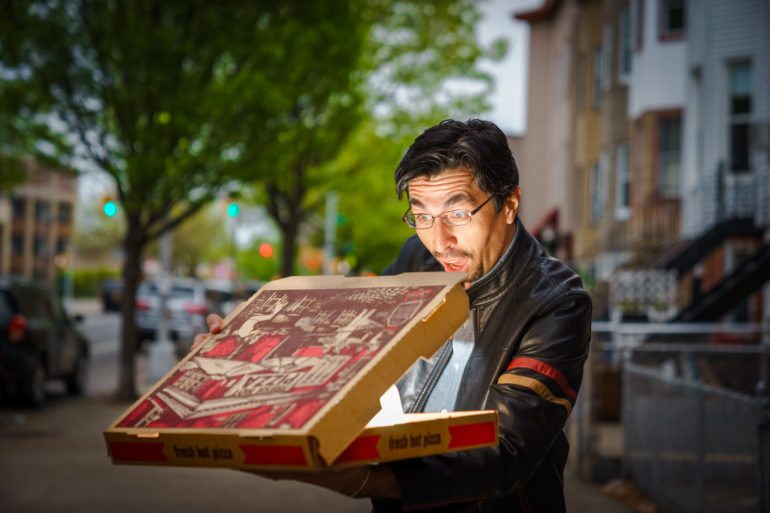
Of course, this doesn’t mean just street photography — you can use the power of ambiguity in portraiture or other types of works too. In the image above, I made a photograph where the light was coming out of the pizza box. And so much could be asked about this image. Photographers might be curious to know how I shot it. Pizza lovers would want to know where the pizza is from. Others might want to know if he really found some sort of holy grail pizza.


The two images above have some ambiguity that makes us question things. The one on the left makes us wonder why this guy is in a blazer and full clothing on the beach when the woman is clearly dressed for summer. Considering what’s in his hand, we then also wonder if he’s drunk or not.
The image on the right is simply a beautiful moment then then makes us wonder what she’s looking at or waiting for. They have different levels of ambiguity for sure — but they can both have a moving effect on someone viewing them.